Analysis · The ghost-demo study
Three in ten Steam demos show no sign of a player
We tracked roughly 2,100 Steam demos from the day they went live this June, polling each one's live player count over and over, the way you would take a pulse. Of the 811 we can score on a matched basis, 29% show no evidence that anyone played them.
Not a small audience. Not a slow start. No players in any reading, and never a single review on their own demo page. The median demo peaked at one person playing at once. The 90th percentile peaked at 65. The top 1% cleared 2,339, and one broke 9,000. Everyone else split the scraps.
This is the part of Steam nobody writes about, because the trade press covers the demos that already won.
Counting this is harder than it looks
A demo's player count is not a number you can just read off. It is a sample, and two things quietly corrupt it.
A poll is one instant. We read live players in a morning window, near the low point of Steam's daily cycle. Among demos we can prove were played, a single reading comes back zero 76% of the time when the true peak is one player, and 62% of the time when it is two. Three readings of a genuinely played one-player demo all come back empty about 45% of the time.
The tracker looks harder at games that are doing well. Demos that peaked at zero carry a median of 3 polls; demos that peaked at 10 or more carry 11. So a naive "peak player count over all polls" lets the statistic choose its own sample size, and the games most likely to look dead are the games it looked at least. Any maximum taken over a series whose length was set by that maximum will overstate the silence.
So we do two things. Every demo is scored on its first three polls only, whatever happened afterwards, which puts a thriving demo and an abandoned one on the same basis. And player counts never get the last word: reviews and follower counts are cumulative, so an unlucky sampling hour cannot erase them.
On that basis, of 811 June demos:
- 36% show no players in any of their first three readings
- 29% show no players and have never earned a review on their own demo page, which is our reported figure: no evidence of play
- 18% show no players, no reviews, and no follower growth: no detectable audience at all
The distance between the first two lines is worth sitting with. 18% of the cohort looks dead on player counts alone while a cumulative counter says otherwise. Those demos had players we never caught in the act.
The number also depends on how many readings you demand: 39% on two polls, 36% on three, 30% on five. We report the three-poll figure because three is the median a demo receives before the tracker drops it.
Followers are destiny
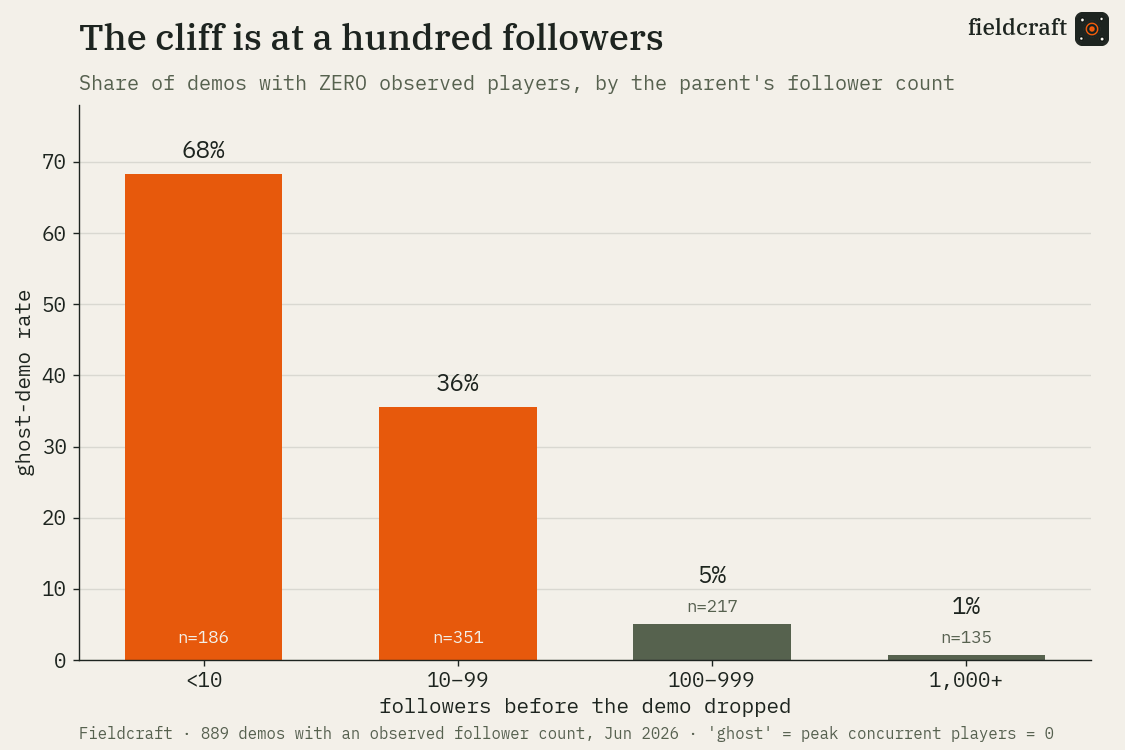
If the game already had a following before the demo dropped, the demo got played. Among the 671 demos where we could read a follower count:
- under 10 followers: 60.4% show no sign of a player (n=111)
- 10 to 99: 37.6% (n=258)
- 100 to 999: 5.9% (n=187)
- 1,000 or more: 0.9%, one game in 115 (n=115)
That is a 60-fold spread across the range, and in the regression follower count is the only variable significant at p<.01. It is not close. The demo does not earn its players in its first 48 hours. It inherits them, or it does not. You mostly win or lose the discovery game before the demo ships.
The store page tells you who already had an audience
The obvious next question is what a developer can do about it, and here the honest answer is uncomfortable.
Taken one at a time, the store-page signals look strong. Demos shipping English-only show no sign of a player 40.1% of the time (n=269) against 18.9% for those in five or more languages (n=391). Demos with the weakest store pages run 41.2% (n=131) against 23.2% for the strongest (n=297). Demos with no trailer run 38.5%, though on only 39 games.
Put follower count in the model and all of it goes flat. Trailer lands at an odds ratio of 1.69 with a confidence interval of 0.66 to 4.32. Screenshots come in at 1.09 (0.89 to 1.33). Languages at 0.96 (0.81 to 1.15). None of them is distinguishable from no effect at all.
Stacking the flags does not rescue it either. Demos with no red flags run 38.8% (n=178), one flag 50.0% (n=160), two flags 50.0% (n=30). The three-flag cell contains a single game, which is why it is not drawn. (A chart titled "Three avoidable mistakes" stood here until 12 September. Its title claimed what this paragraph denies, and the set it stacked has since been re-tested on a second cohort and retracted. See the update below.)
The reading we are confident in: those raw gaps are real, but they are mostly telling you which developers already had an audience, not what the store page did for them. A polished page and a following tend to arrive together.
Novelty deserves its own line, because the intuitive story is that an unusual game gets noticed. We cannot find that. An unusual tag combination comes back at an odds ratio of 1.26 (1.03 to 1.55) in two of our three models, pointing very slightly toward more silence rather than less, and at 1.18 and not significant in the third. The effect is weak in every direction we look at it. Originality earns you a write-up. On this evidence it does not, by itself, earn you a player.
Update, 12 September: a second reading each day, and the red flags re-tested
Two things changed since this was written, and both move the numbers, so here they are.
We now take a second reading. Since 17 August every tracked demo is read twice a day, once in the morning window described above and once around 19:00 UTC. The two readings are not a peak and a trough. For demos they are nearly symmetric: the evening comes back higher on 18% of days, lower on 13%, and the sum of all readings is within 1% either way. What the second reading buys is a second draw. On 1,142 brand-new demos that dropped between 15 August and 8 September, each with both readings on its first three days:
- 49.3% show no players and no reviews on the morning readings alone
- 37.9% on both readings, which is now our reported figure for that cohort
- 29.3% show no players, no reviews, and no follower growth
One in four of the morning zeros was a demo that had players that same day. The June figure of 29% stands as what one reading a day measured, and cannot be re-scored: there was no second reading then.
The two cohorts are not the same population, so the September figure being higher than June's is not a trend. June was full of Next Fest demos with fest placement behind them; the late-summer cohort had a median of six followers when its demo dropped, and no fest.
The red flags did not survive a second cohort. This post said the store-page signals went flat once follower count was in the model, and the chart that stood above that paragraph said the opposite in its title. We have now re-fitted 21 store-page and category variables on the new cohort, with follower count held fixed, brand-new demos only, and checked each result by splitting the cohort in half.
Among the things a developer can change on the page, one survives, and only just. Demos shipping English-only show no sign of a player 50.9% of the time against 32.4% for the rest, among demos with fewer than 100 followers (n=450 and 624), and the rate falls monotonically with language count: 49.5% English-only, 35.5% at two to four languages, 31.8% at five to nine, 21.7% at ten or more. With followers in the model the odds ratio is 0.84 (0.71 to 0.99). It holds in one half of the cohort and vanishes in the other, so treat it as a modest effect, not a rule.
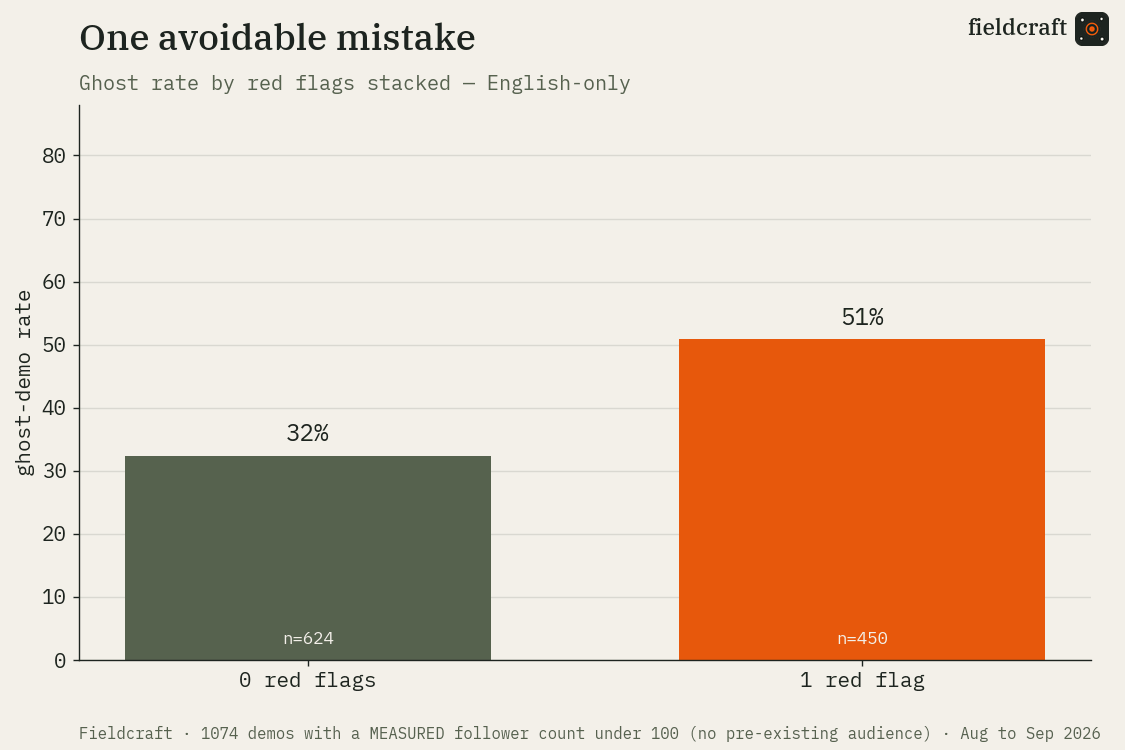
Screenshot count and trailer do nothing. Screenshots come in at 1.16 and point the wrong way: more screenshots, slightly more silence. Trailer is 0.85 and not distinguishable from no effect. The June stack of three was a pattern in one cohort, and we should not have drawn it as advice.
What does predict silence, with the audience held fixed, is what kind of game it is and whether the demo is really new:
- Controller support listed: odds ratio 1.64 (1.24 to 2.18), and it replicates in both halves of the cohort.
- Any multiplayer category: 1.58 (1.11 to 2.25). A multiplayer demo with nobody in it is not unplayed so much as unplayable, and the ghost label overstates failure for that class.
- A re-featured demo, one re-dated by a showcase rather than newly released: 2.08, replicating in both halves, while its raw rate is no higher than a brand-new demo's. Its crowd already came, before our first reading. That is why the figures above are for brand-new demos only.
- How finished the game looks, from a model's read of the header and screenshots: 0.76 per standard deviation, the strongest thing a developer controls, and the same signal that has held up elsewhere in our data.
- Steam Cloud listed: 0.64 (0.48 to 0.86), protective, and it nearly replicates. We read that as a marker of a build that is further along, not as advice to enable cloud saves.
The honest sentence, then: with the audience held fixed, the only page element that still moves the odds is localisation, and modestly. The strong predictors are what the game is, whether it looks finished, and whether the demo is actually new. Followers are still destiny. The cliff by follower count on the new cohort has the same shape as June's: 52.5% under ten followers, 21.9% at ten to 99, 6.2% at 100 to 999, 0.0% at a thousand or more.
The fine print, because we would rather you trust us
811 of roughly 2,100. A demo with fewer than three readings by June 28 cannot be scored on a three-poll basis, and that exclusion correlates with traction, so read 29% as the best available estimate rather than a census.
Follower coverage is 671 of 811 (83%). The rate is 26.2% among demos where we could read a count and 42.1% among those we could not, which is exactly why a missing follower count must never be treated as zero. Of the 144 demos we call silent on every channel, 129 carry fewer than two follower readings, so that channel could not have contradicted them even if they were alive.
Follower counts come from the public Steam group member list, which exists for about seven games in eight. Most of this cohort dropped around June's Next Fest, where placement is its own hand on the scale.
We will keep watching the three in ten nobody else does.
Fieldcraft
The instrument that produced this runs every morning.